No-show tracking across five clinics in one dashboard

When you're managing multiple dental clinics, no-shows become an exponential problem. Each location has its own appointment book, its own team tracking missed appointments in spreadsheets or not at all, and no single person can see the full picture. The result: thousands of pounds in lost revenue scattered across sites, with no systematic way to identify which clinics need intervention, which patients are repeat offenders, or whether your follow-up processes are actually working.
Multi-clinic no-show tracking consolidates missed appointment data from all your locations into a single dashboard, showing patterns by site, treatment type and patient, enabling practice managers to compare performance, identify systemic issues and deploy targeted recovery strategies that reduce revenue loss across the entire group.
Key Takeaways
- Centralised no-show tracking reveals which clinics underperform and why, enabling evidence-based intervention rather than guesswork across multiple sites
- Automated pattern detection identifies repeat no-show patients and high-risk appointment types before they become chronic revenue drains
- Real-time dashboards let practice managers compare clinic performance, track recovery success rates and forecast revenue impact without manual spreadsheet reconciliation
- Systematic follow-up workflows triggered by no-show events ensure every missed appointment receives appropriate contact within hours, not days or never
Why spreadsheet no-show tracking fails at scale
A single clinic can just about manage no-show tracking in an Excel file. Someone notes each missed appointment, perhaps flags patients who do it twice, and the treatment coordinator follows up when they remember. It's inefficient but survivable. Add a second clinic and the system fractures. Each location maintains its own record—if they maintain one at all. Add a third, fourth or fifth clinic and you're managing five separate tracking methods with no way to see the total picture.
The fundamental problem: spreadsheets don't aggregate, don't trigger actions and don't show you comparative performance. You cannot quickly answer "which clinic has the highest no-show rate this month?" or "how many patients missed appointments at multiple locations?" or "what percentage of our no-shows were implant consultations?" These questions require manual data collection from each site, by which time the information is already outdated and the follow-up opportunity has passed. Practice managers end up making decisions based on anecdote from the loudest site rather than evidence from across the group.
Worse still, without centralised tracking, you cannot identify systemic issues. Is one clinic's high no-show rate due to a booking process problem, a team training gap or simply a different patient demographic? You'll never know if each location operates in isolation. The lack of visibility means effective interventions at one site never reach the others, and poor practices spread unchecked.
What a multi-clinic no-show dashboard actually shows you
A proper no-show tracking dashboard for multiple clinics displays comparative data at a glance. You see each location's no-show rate as a percentage of total appointments, updated in real time throughout the day. You see which treatment types generate the most missed appointments—new patient consultations, hygienist visits, implant follow-ups—broken down by clinic. You see individual patient records across all sites, so if someone no-shows at Clinic A and books at Clinic B, you know their history before they waste another appointment slot.
The dashboard should show temporal patterns: which days of the week generate more no-shows, which times of day, which booking windows (same-day appointments versus those booked weeks in advance). This reveals whether your scheduling policies need adjustment. It should track follow-up actions: which missed appointments received a call or message within two hours, which within 24 hours, which never. This measures whether your team is executing the recovery process or letting leads evaporate.
Most importantly, it shows financial impact. Each no-show represents lost treatment value—a missed hygienist appointment might be £80, a missed implant consultation potentially £3,000 to £5,000 in eventual treatment. Aggregated across five clinics over a month, you see the true revenue cost of the problem. This transforms no-show tracking from an administrative task into a business priority with board-level visibility.
How do you identify chronic no-show patients across multiple locations?
Chronic no-show patients move between clinics. They book at your Harley Street location, don't attend, then book at your Bromley clinic a month later under the same name and phone number. Without connected tracking, each clinic treats them as a first-time offender. With centralised tracking, their full history appears instantly. The system flags patients with two or more no-shows across any location, and many dashboards allow you to set clinic-wide policies: require payment deposits for repeat offenders, limit them to same-day bookings only, or place them on a 'confirm 24 hours before' list.
This cross-clinic visibility prevents the same person from wasting multiple appointments across your group. It also reveals whether certain patient sources generate higher no-show rates—perhaps enquiries from a particular advertising channel or demographic consistently fail to attend. You can then adjust your booking criteria or follow-up intensity for those sources.
Automated follow-up: turning missed appointments into rescheduled revenue
The gap between a no-show occurring and follow-up contact determines recovery success. Wait 24 hours and the patient has booked elsewhere or lost interest. Contact within two hours and you can often rebook for later that week, recovering most of the treatment value. Manual tracking cannot achieve this speed at scale—someone has to notice the no-show, find the patient's details, craft a message and send it, repeated dozens of times per day across multiple clinics.
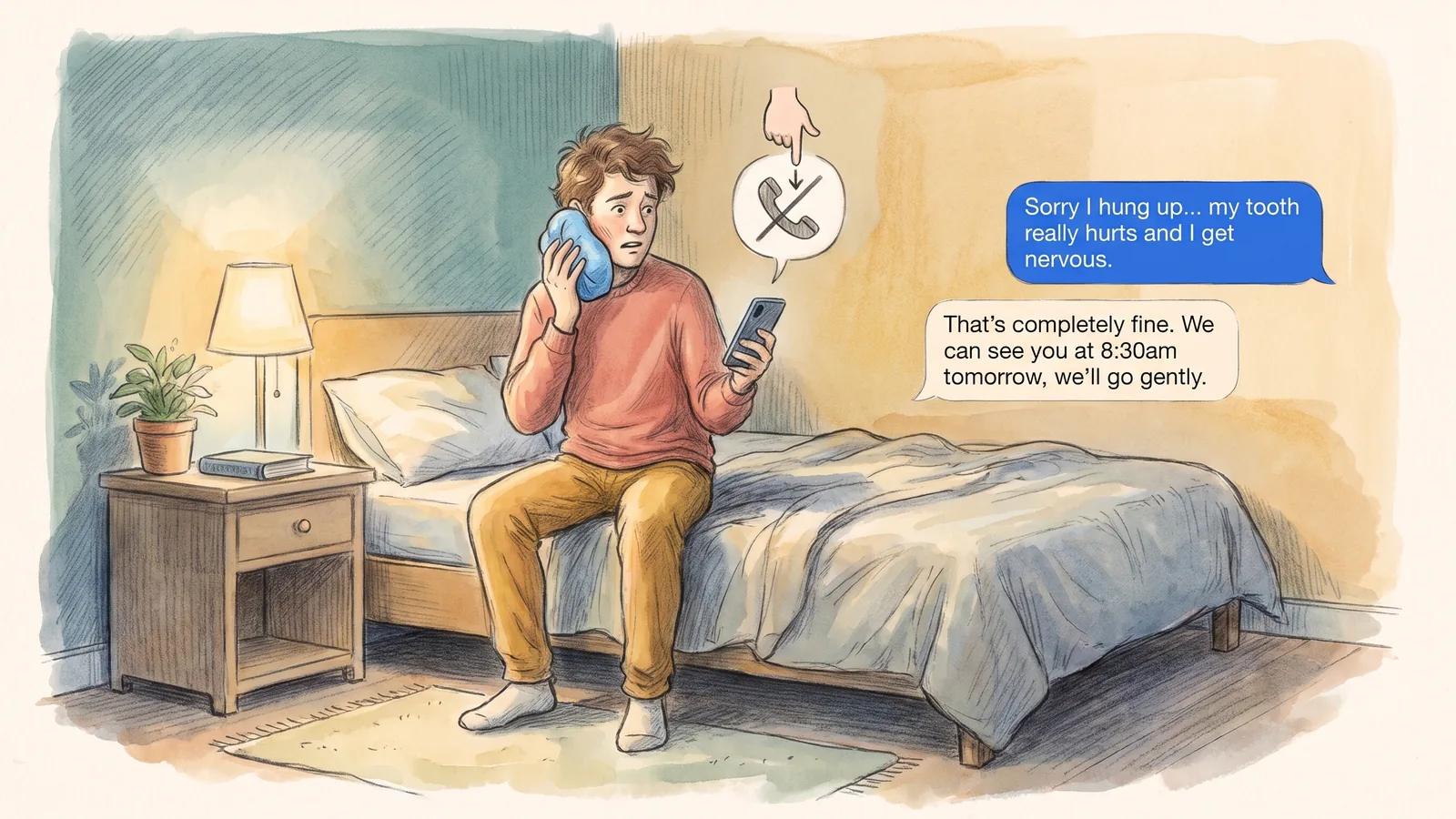
Automated no-show workflows trigger the moment an appointment is marked as missed. The system sends an immediate WhatsApp message or SMS: "We're sorry we missed you today for your 2pm appointment. We'd still love to see you—would Thursday at 10am work?" The tone is non-confrontational, the ask is specific. If the patient doesn't respond within four hours, a second message follows. If they engage, the conversation routes to the treatment coordinator for that clinic, who can rebook while the patient is still interested.
CareDental's win back feature handles this automatically each morning. The AI reviews every no-show and quiet lead from the previous day across all connected clinics, then drafts a personalised follow-up message for each. The treatment coordinator at each site sees only their patients, reviews the suggested messages, edits if needed and approves sending. Nothing goes out without human oversight, but the AI handles the detection, drafting and prioritisation that would otherwise consume hours of coordinator time.
Comparing clinic performance: which sites need intervention?
Once you have centralised tracking, performance comparison becomes straightforward. You see that Clinic A has a 12% no-show rate while Clinic E has 6%. This demands investigation. Is Clinic A's confirmation process broken? Is their demographic different? Do they overbook more aggressively, leading to longer wait times that frustrate patients? The dashboard shows the numbers; your job is to diagnose why.
Often the problem is process, not people. One clinic might send appointment confirmations 48 hours before while another sends them seven days before—the latter gives patients more time to forget or change plans. One might have a particularly efficient treatment coordinator who calls patients the day before high-value appointments; others rely solely on automated SMS that patients ignore. By identifying the top-performing clinic's methods, you can standardise best practices across the group.
Some dashboards show individual staff performance if appointments are linked to the person who booked them. This reveals whether certain team members have higher no-show rates, suggesting they need training in qualifying patients or setting expectations during booking. It's not about blame; it's about targeted support where it's needed.
What patterns predict high-risk appointments?
Not all appointments carry equal no-show risk. Data across multiple clinics reveals consistent patterns. New patient consultations for high-ticket treatments like implants or orthodontics have higher no-show rates than routine hygienist visits—the former involve significant emotional and financial decision-making, the latter are established habits. Appointments booked weeks in advance have higher no-show rates than same-week bookings, because circumstances change and commitment fades over time.
Evening and weekend appointments often see lower no-show rates than midday slots, because patients booking out of regular hours are self-selecting for motivation—they're fitting dental care around work, which means they've planned carefully. First thing Monday morning appointments have higher no-show rates than other weekday times, possibly because patients book them optimistically then realise Monday morning is chaotic.
Armed with these patterns, you adjust policy. High-value new patient consultations might require payment deposits or same-day confirmation calls. Long-lead bookings for expensive treatments might receive reminder messages at 14 days, seven days, three days and 24 hours before the appointment, rather than a single reminder. You allocate coordinator time proportionally—spend more effort confirming the £4,000 implant consultation than the £60 hygienist visit.
How does real-time visibility reduce revenue loss?
Revenue loss from no-shows is not just the value of the missed appointment; it's the opportunity cost of that slot, which could have been filled by another patient. Real-time visibility means practice managers see no-shows as they happen and can immediately offer that slot to patients on waiting lists or push it to same-day booking channels. A 10am implant consultation no-show at 10:15am can become a 1pm emergency appointment if you act fast. Without visibility, that slot stays empty all day.
Real-time tracking also enables dynamic overbooking. If your dashboard shows that Friday afternoons have a 15% no-show rate, you can book slots at 110% capacity, knowing statistically that some won't attend. This requires confidence in your data—you cannot overbook without accurate tracking—but done correctly it maximises chair utilisation without excessive waiting times.
The financial impact compounds when you track it properly. A five-clinic group might collectively experience 60 no-shows per week. If 30% of those are for high-value consultations averaging £50 treatment value that never materialises, that's 18 missed opportunities per week at £50 each, totalling £900 weekly or £46,800 annually. If your follow-up process recovers even half of those patients, you've added £23,400 annual revenue with no additional marketing spend.
Role-based access: showing each team member what they need
A group practice manager needs to see all clinics. A site-level practice manager needs to see only their location. A treatment coordinator should see their own patients and no-show follow-up tasks, not the financial aggregates. Role-based access ensures each person sees relevant data without overwhelming them or exposing commercially sensitive information inappropriately.
This also protects patient privacy. Treatment coordinators need to see patient names and contact details for follow-up, but they don't need to see aggregated financial forecasts or comparative performance data that might create unhelpful competition between sites. Practice managers need strategic visibility but not necessarily access to individual patient conversations. The multi-clinic dashboard structure should enforce these boundaries automatically based on login credentials.
Integrating no-show tracking with your existing practice management system
Most UK dental clinics use Software of Excellence, Dentally or similar practice management systems that record appointments and patient records. No-show tracking dashboards typically integrate with these systems via API, pulling appointment data automatically so no one enters information twice. When an appointment status changes to "did not attend" in your practice management system, that event triggers tracking and follow-up workflows in your dashboard.
This integration is crucial for multi-clinic setups where each site might use the same practice management system but with separate databases. The tracking dashboard connects to all instances, aggregating data while maintaining the separation required for data protection and operational independence. Some systems also sync with Google Calendar or other scheduling tools if clinics use those alongside their main practice management system.
CareDental works alongside your existing practice management system—it does not replace it. The follow up and win back features pull missed appointment data from your system, generate follow-up tasks and conversation summaries for your treatment coordinators, and track which patients respond and rebook. The clinical record stays in your practice management system; CareDental handles the communication and recovery workflow that happens before someone becomes (or returns to being) an active patient.
Weekly forecasting: predicting no-show impact before it happens
Once you have several months of no-show data, patterns become predictive. You know that your group typically sees 8-10% no-show rate, but it climbs to 12% in the week before Christmas and drops to 6% in September when people return from summer holidays. You know that rainy weather correlates with higher no-shows—people don't want to leave the house. You know that if Monday is a bank holiday, Tuesday's no-show rate rises because patients assumed the clinic was closed all week.
Advanced tracking dashboards incorporate these patterns into weekly forecasts. They predict next week's no-show count and lost revenue value based on historical data, appointment types booked and external factors. This lets practice managers prepare: allocate more coordinator time to confirmation calls during high-risk weeks, adjust overbooking ratios, pre-emptively contact high-value appointments with extra confirmation touchpoints. You move from reactive (dealing with no-shows after they happen) to proactive (reducing them before they occur).
CareDental's know feature allows managers to ask questions about their clinic data in plain English: "What was our no-show rate last month?" or "Which patients missed appointments twice this quarter?" The system answers from your actual figures, not generic estimates. It also provides those weekly forecasts of new leads and treatment value, checked afterwards against what actually happened, so you can see whether your no-show predictions were accurate and refine the model over time.
What compliance and data protection considerations apply?
No-show tracking involves processing patient names, contact details and appointment history across multiple locations. Under UK GDPR, you must have a lawful basis (usually legitimate interest in managing appointments and reducing waste), inform patients that you track this data, and allow them to request deletion or object to processing. Your privacy notice should explicitly mention that missed appointment data is recorded and may be used for follow-up contact.
When tracking spans multiple clinics, ensure each clinic's data controller responsibilities are clear and that patients understand their data may be visible to group-level managers if they interact with multiple sites. The Information Commissioner's Office provides guidance on sharing patient data within healthcare organisations. Most importantly, restrict access via role-based permissions so only those with a legitimate need see patient-identifiable information.
Automated follow-up messages must respect consent. Patients who have opted out of marketing communications can still receive appointment-related messages (these are typically considered service messages, not marketing), but they must be able to opt out of follow-up messages specifically. CareDental's safeguards include allowing patients to reply STOP at any time to opt out, and clearly stating in the first automated message that it's from an AI assistant, ensuring transparency about automated processing.
Frequently Asked Questions
Can I see no-show patterns by treatment type across all my clinics?
Yes, most multi-clinic dashboards allow filtering by treatment type (hygienist, consultation, implant follow-up, etc.) across all locations. This shows whether certain treatments have consistently higher no-show rates group-wide, suggesting the need for treatment-specific booking policies such as deposits or enhanced confirmation protocols.
How quickly can automated follow-up recover a missed appointment?
Automated workflows can send follow-up messages within minutes of a no-show being recorded in your practice management system. Response rates are highest when contact happens within two hours of the missed appointment, while the patient still remembers they should have attended and before they've made alternative plans or booked with a competitor.
Does centralised tracking work if each clinic uses different practice management software?
Some advanced dashboards can integrate with multiple practice management systems simultaneously, though setup is more complex. If standardising on one system across your group isn't feasible, choose a tracking platform with broad integration capabilities. CareDental works alongside Dentally, Software of Excellence and other UK dental practice management systems, pulling missed appointment data regardless of which system each clinic uses.
What no-show rate is considered acceptable for a dental clinic?
Industry benchmarks vary, but many UK dental practices experience 5-10% no-show rates. High-value treatments like implants and orthodontics often see higher rates (10-15%) due to the decision complexity involved. The goal is not necessarily zero no-shows—some are unavoidable due to emergencies or illness—but rather reducing preventable no-shows through confirmation, reminder and deposit policies informed by your tracking data.
Turning visibility into action: building systematic recovery workflows
Data without action is just numbers. The purpose of multi-clinic no-show tracking is to enable systematic recovery workflows that run consistently across all locations. This means defining standard operating procedures: every high-value no-show receives a WhatsApp message within one hour, a phone call within four hours if they don't respond, and a final attempt the next day. Every patient with two no-shows in six months requires a deposit for future bookings. Every clinic reviews its no-show dashboard weekly with the practice manager, identifying top concerns and testing interventions.